
Connect surface wetting to operating duty
The coating is intended for assessment on condensation surfaces. The resulting system performance depends on the complete operating environment, including the surface, temperature conditions, condensate and contamination.
Use an application-specific evaluation
Define preparation, application and cure, then assess adhesion and surface behaviour through the planned operating and cleaning cycle. Compare performance under consistent conditions rather than relying on a single water-droplet image.
Compare the Products
Product | Format | Selection Reference |
|---|---|---|
1 kg | 115° water contact angle; <100 nm film; condensation-surface application |
Define the condensation surface
Identify the metal, finish, geometry and access for coating. Describe the vapour, condensate, surface-temperature range, pressure where relevant and expected contamination. Include cleaning chemicals and any mechanical cleaning method. The coating's purpose is assessed on the actual heat-transfer surface, so a convenient flat coupon should be connected to a representative component trial.
Apply and assess a thin coating
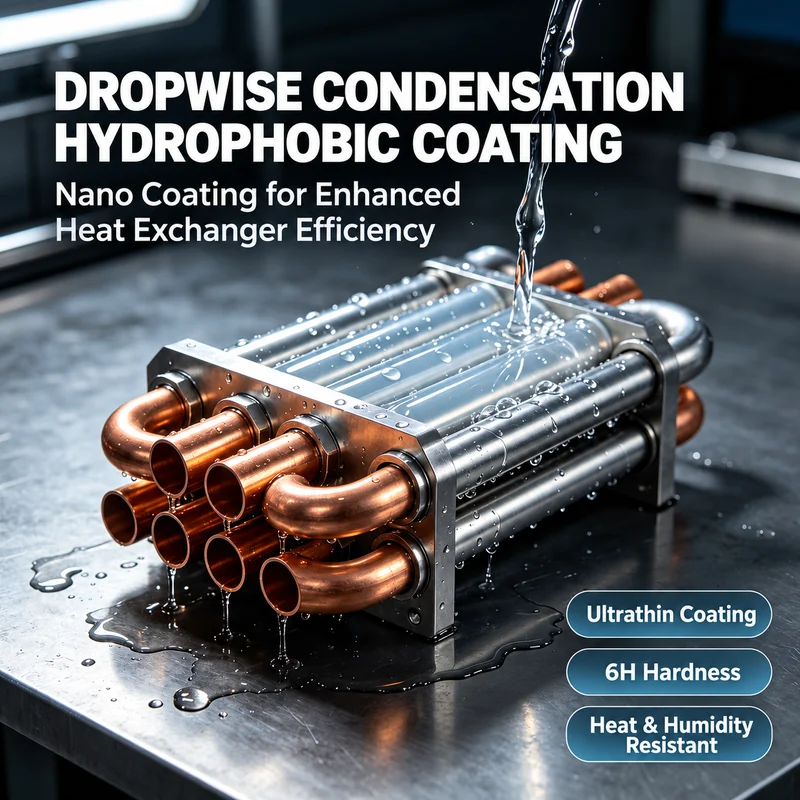
The selected hydrophobic product lists a coating thickness below 100 nm, a water contact angle of 115° and a roll-off angle of 15–25°. Its composition is described as perfluoroalkyl silazane, with dipping and room-temperature or heat-curing routes. Prepare a clean surface and use a controlled coating process. Inspect adhesion and wetting after cure before starting the operating comparison.
Compare operation under matched conditions
Use comparable coated and untreated surfaces under the same vapour, temperature, flow and contamination conditions. Record the measurements needed to determine heat-transfer performance and repeat the comparison after the relevant operating and cleaning cycles. Keep the equipment geometry and measurement method consistent. A visibly different droplet pattern can support the observation, but cannot replace the system-performance measurements.
Durability and supply discussion
The product lists hardness above 6H and an abrasion reference of 200 cycles with #0 steel wool. These are separate surface-property references; they do not define a lifetime in a condenser. Discuss exposure duration, cleaning, access for renewal and any need to protect uncoated areas. The available 1 kg pack supports the quantity discussion once the coated area and process losses are understood.
Application Questions
Does a 115° contact angle guarantee a heat-transfer increase?
No. Determine the result through a controlled comparison under the actual operating conditions and repeat it after relevant service exposure.
What should be included in a cleaning trial?
Use the intended cleaning chemical, temperature, duration and mechanical action, then reassess adhesion, wetting and system performance.
Explore Products
Hydrophobic Coating for Dropwise Condensation
Tell Us About Your Application
Metal type; surface geometry; operating temperatures; condensate; cleaning regime; cure capability; evaluation method.