
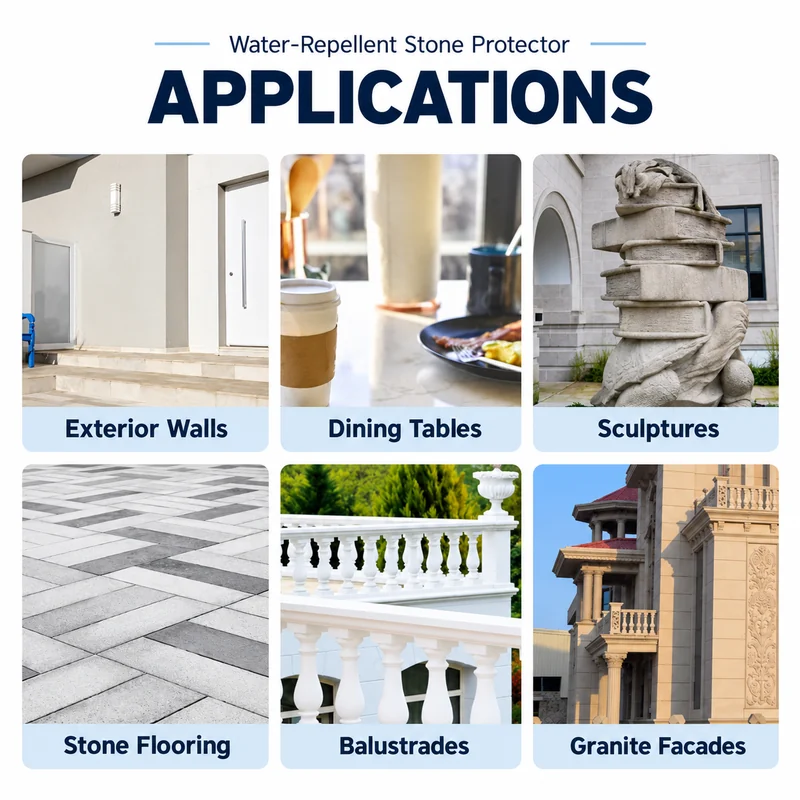
Identify the route of water exposure
A treatment for absorption at a stone surface is different from a repair for water entering through a joint or a damaged waterproofing layer. Inspect the substrate and source of the problem before selecting the material.
Check appearance and service properties
Test colour and gloss on the actual material. For floors, assess slip performance separately from water repellency. Include cleaning and curing time in the application plan.
Compare the Products
Product | Format | Selection Reference |
|---|---|---|
100 g; 1,000 g | XN-5579R; >105° water contact angle; performance tests after at least five days | |
200 ml; 1,000 ml | Ready to use; wipe after about 30 minutes; 24-hour cure | |
300 g to 15 kg | Clear brush-applied sealant; protect from water during 24-hour drying |
Identify the maintenance problem
A stone surface that absorbs water, a tile floor that is difficult to clean and a leaking joint are different problems. Trace the water route and inspect cracks, joints, drainage and existing finishes. Use stone treatment for the appropriate surface-maintenance task, tile treatment for a compatible tile surface and clear sealant for the agreed waterproofing repair area. Repair structural or moving defects with a suitable system first.
Stone treatment: appearance and cure
XN-5579R can be sprayed, dipped or wiped, with spraying preferred for uniform coverage. Compare a cured trial with untreated material for colour, gloss and staining behaviour. Room-temperature processing allows 24 hours before packing; compatible components can use 150°C for 30 minutes. Leave at least five days before performance testing. Natural and engineered stones should be assessed separately, including resin-filled areas.
Tile treatment: reopening the area
Clean the tile face and joints, remove residues and allow the area to dry. Apply the ready-to-use coating thinly at 5–35°C, wipe residual material after approximately 30 minutes and allow 24 hours of protected curing. Prevent traffic and water during this stage. Check uniformity and perform the relevant floor-slip assessment before reopening; a 110° water-contact angle is not a slip classification.
Clear waterproofing and maintenance records
For a compatible surface-waterproofing repair, apply clear sealant to a sound, dry area and protect it from water during the 24-hour drying period. Record treated boundaries, product, application date and cleaning method. Inspect after service exposure and address worn or damaged areas promptly. Provide photos, material type, floor or wall use, area and available downtime with the enquiry.
Application Questions
Can one trial cover natural stone and glazed tile?
No. Test each finish for appearance, adhesion and the intended surface function, using the corresponding product and curing process.
What information helps distinguish coating work from a leak repair?
Show the water-entry location, joints, cracks and surrounding area. Describe when water appears and whether it comes through the surface or from behind it.
Explore Products
Hydrophobic Nano Coating for Stone Surface Protection
Anti-Slip Hydrophobic Coating for Tiles
Bucket-Packaged Clear Waterproof Sealant
Tell Us About Your Application
Material and surface finish; photos; water exposure; wall or floor use; area; downtime; preferred packaging.