
Selection & application guide
What Water Beading Tells You About a Hydrophobic Surface
Water beading shows how water interacts with a surface under the conditions observed. It is a useful surface observation, but it does not by itself establish waterproofing, electrical protection, long-term durability or improved heat-transfer performance.
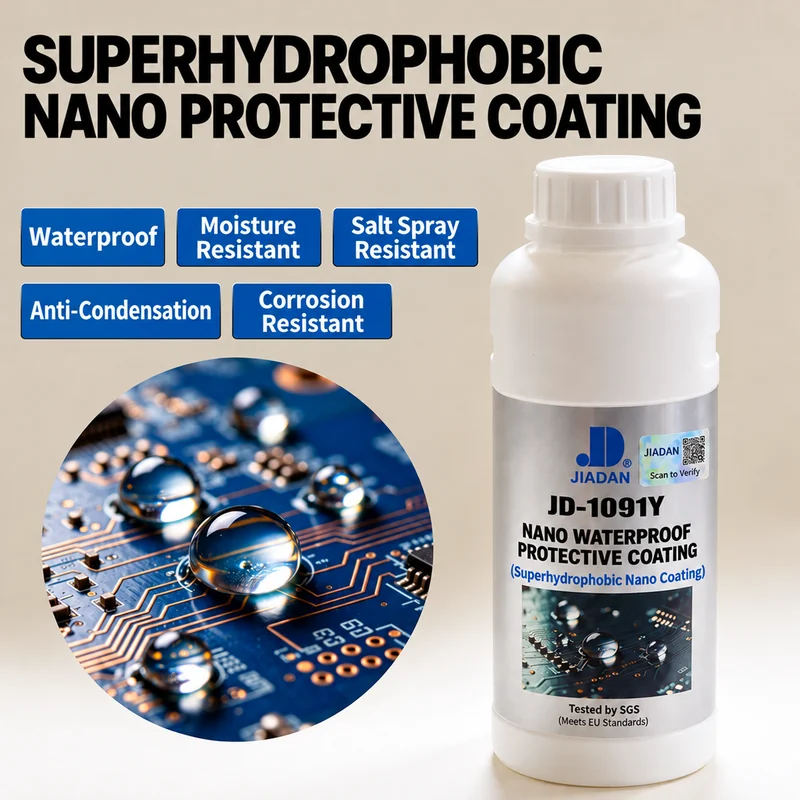
Separate the observation from the required function
A photograph of rounded water droplets shows a wetting effect. An electronic assembly may additionally need electrical and environmental tests. A stone treatment may need an absorption and appearance assessment. A condensation surface needs evaluation under the actual operating duty. Start with the function the buyer needs to verify.
Use measurements with their conditions
Contact-angle values are more useful when the substrate, preparation, curing, measurement method and test conditions are identified. Different surfaces or methods can produce different results. Compare like-for-like data rather than treating an isolated angle as a universal product guarantee.
Include cleaning and service exposure
Initial water behaviour can change after abrasion, contamination, cleaning or thermal exposure. Include the service conditions that matter to the intended application. For electronics, also consider connection areas and the compatibility of cleaning or rework processes. For decorative objects, check whether the treatment changes colour or gloss.
Use a relevant sample
Apply the selected product to the actual material using the intended process. Record preparation and curing, then assess both the surface effect and the project's functional requirement. Share the test method and observations with the product enquiry so a demonstration can be connected to the purchasing decision.
Read the five product references correctly
Application | Selected water-contact-angle declaration | Additional question |
|---|---|---|
PCBA | ≥155° | Does the assembly retain required electrical and environmental performance? |
Dropwise condensation | 115° | Does measured heat-transfer performance meet the operating target? |
Crafts | 160° | Does the treatment preserve appearance and withstand handling? |
Stone | >105° | Does the surface meet absorption, stain and cleaning requirements? |
Tiles | 110° | Does the treated floor meet the required slip assessment? |
The values come from different product descriptions and do not represent a controlled test of every product on the same substrate.
Static angle and droplet movement answer different questions
A contact angle describes the shape of a droplet at the surface under the measurement conditions. A roll-off angle describes the tilt at which a droplet moves under the stated procedure. The condensation coating lists a 15–25° roll-off reference alongside a 115° water-contact angle. Keep these measurements distinct, including droplet size and test method in any formal comparison rather than replacing one number with the other.
Curing changes the timing of evaluation
Initial appearance may develop before a product is ready for its full performance assessment. XN-5579R stone treatment allows 24 hours before packing at room temperature, but calls for at least five days before performance testing. Tile treatment requires a protected 24-hour cure. Craft spray uses a 60-minute drying reference. Follow the timing for the selected material before comparing a treated and untreated sample.
A useful durability comparison
Record the initial result, expose the sample to the cleaning or wear relevant to its use and repeat the same measurement. Include appearance and adhesion as well as wetting. A treatment that beads water after initial application but fails the required cleaning cycle has not met the complete application requirement. Share both the test conditions and the observations when discussing the next trial.
Discuss your application
Tell us your surface, application process and quantity. Free samples are available with customer-paid freight.
- sales@leadercoat.com
- Phone & WhatsApp
- +86 151 7525 6533
- Sample support
- Free samples. Customer-paid freight.